
Soul Kiss
Translation from German:
It almost seems as if the master of suspense, Alfred Hitchcock, directed the creation of Olivia Newton-John’s latest album. True to his motto of building slowly to a climax and then delivering a bang just before the audience’s patience is stretched to its limit, she timed the release of her album “Soul Kiss” perfectly: In January of last year, amidst a flurry of photographers’ flashbulbs at MIDEM in Cannes, she signed a long-term contract with a new record label, granting her absolute superstar rights.
This is hardly surprising, given that she is one of, if not the, best-selling female artists in an industry largely dominated by male stars. And she promised something special for her debut.
Then came the long radio silence, because Olivia Newton-John and her long-time partner and producer John Farrar, who had learned the ropes of show business from the artist’s perspective with the Shadows and knew exactly what was going on, withdrew from the public eye and worked on a new concept for Olivia: The girlish image, which no longer quite suited the now thirty-eight-year-old singer, had to be replaced with a new one that reflected her still captivating appearance, despite her advanced age.
Good advice was readily available, as Olivia and John are seasoned pros in the business and know every trick in the book, familiar with all the crucial superficialities that can make an impression.
First up was the hairdresser. The demure, conservative housewife cut was transformed into a modern, yet not overly flamboyant, hairstyle.
Then the tailor, timelessly elegant yet with a touch of flair, created the new outfit — tempting as a candy wrapper: concealing everything yet whetting the appetite for what lies within.
And last but not least, the most important thing — the music: without diminishing what has brought Olivia Newton-John success over the years — the catchy pop songs — influences from Black music and jazz were increasingly incorporated. The best example of this is the title track of the new album, which is also the first single: “Soul Kiss,” a number that Tina Turner or Diana Ross could easily have in their repertoire, so soulful and soulful is the song.
But therein lies the great danger for the “new” Olivia Newton-John: that she has taken on more than she is capable of delivering. The new style takes some getting used to. The contrast between the Black song, the soulful backing vocals, and Olivia’s typically white voice makes it very difficult to grasp at first. But only at the beginning, because with repeated listens, this very contrast creates an uncanny additional appeal that one simply doesn’t want to miss. One becomes almost addicted to it.
The immense competitive pressure forced Olivia Newton-John to make these radical changes, because she has a position to defend that was handed to her in 1971 with her first single, Bob Dylan’s “If Not For You.” And one she hasn’t relinquished since: the role of the most popular white singer of popular music.
Quite the contrary, in fact. Record after record, year after year, she added another piece to the mosaic, further solidifying her success with well-placed film appearances and infrequent, but all the more successful, concert tours.
No fewer than three Grammys, the Oscars of the recording industry, and over 100 million records sold worldwide attest to this impressive achievement. And it seems the song of success is far from over for Olivia Newton-John.
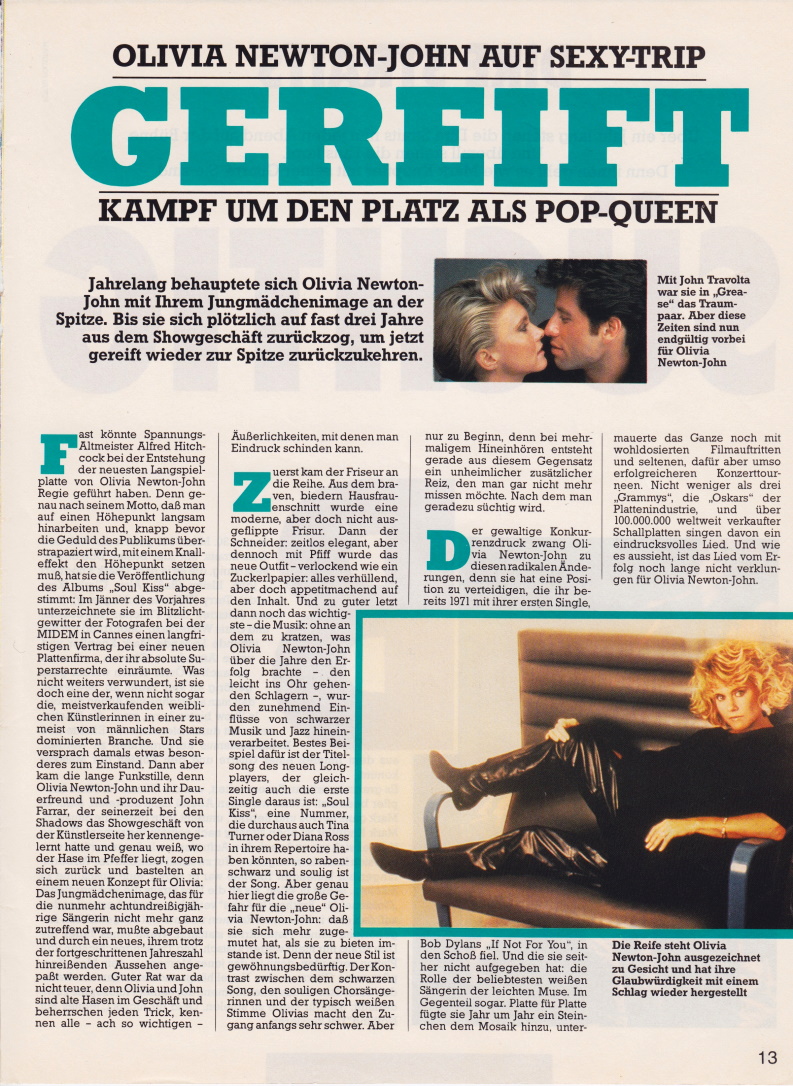
Maturity suits her perfectly and has instantly restored her credibility.
Photo captions: She and John Travolta were the dream couple in "Grease." But those days are now definitively over for Olivia Newton-John.
Maturity suits Olivia Newton-John perfectly and has instantly restored her credibility.