
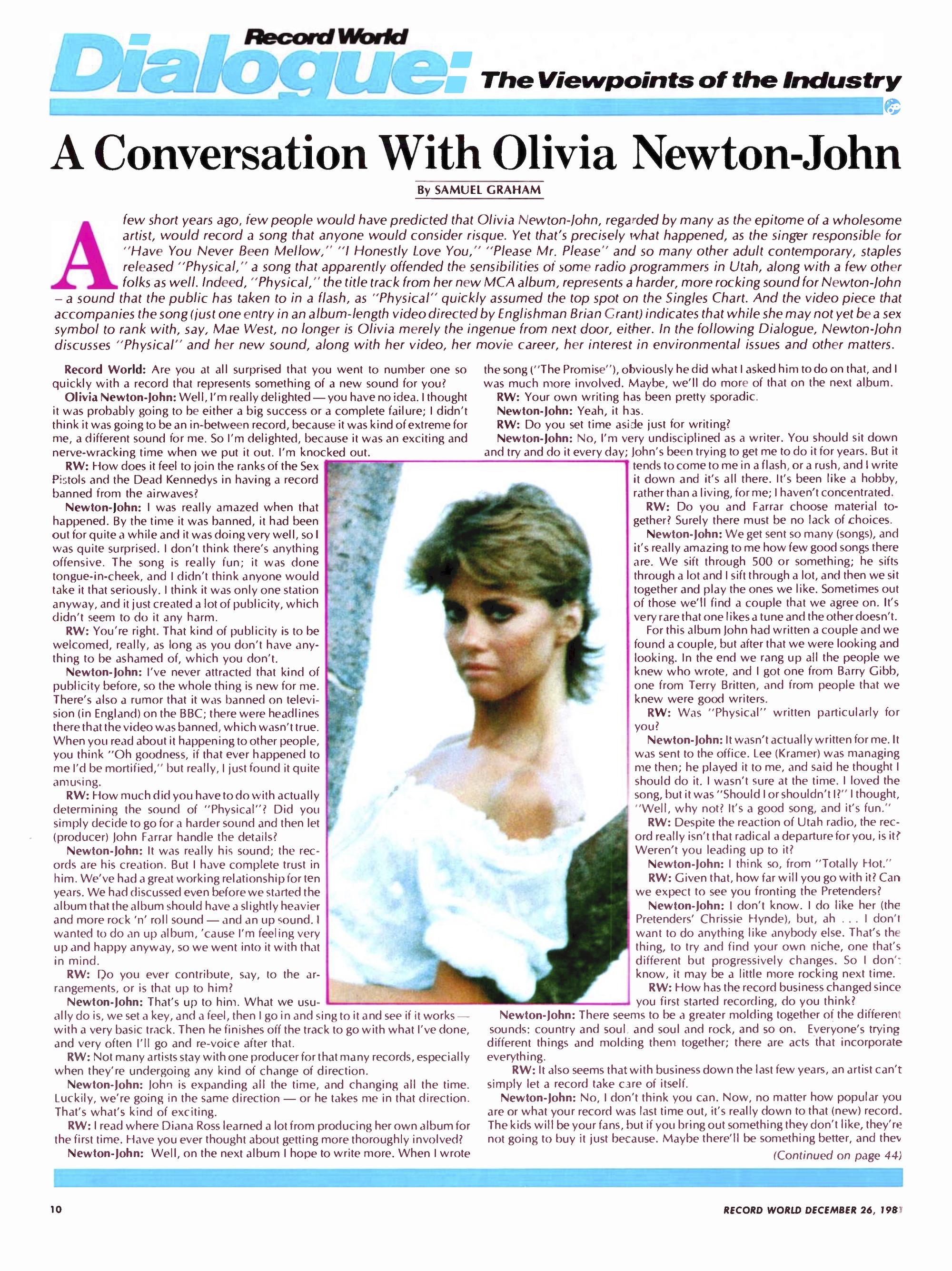
Physical Cover and Conversation
By Samuel Graham
A few short years ago, few people would have predicted that Olivia Newton-John, regarded by many as the epitome of a wholesome artist, would record a song that anyone would consider risqué. Yet that’s precisely what happened, as the singer responsible for “Have You Never Been Mellow,” “I Honestly Love You,” “Please Mr. Please” and so many other adult contemporary, staples released “Physical,” a song that apparently offended the sensibilities of some radio programmers in Utah, along with a few other folks as well.
Indeed, “Physical,” the title track from her new MCA album, represents a harder, more rocking sound for Newton-John - a sound that the public has taken to in a flash, as “Physical” quickly assumed the top spot on the Singles Chart. And the video piece that accompanies the song (just one entry in an album-length video directed by Englishman Brian Grant) indicates that while she may not yet be a sex symbol to rank with, say, Mae West, no longer is Olivia merely the ingenue from next door, either. In the following Dialogue, Newton-John discusses “Physical” and her new sound, along with her video, her movie career, her interest in environmental issues and other matters.
Record World: Are you at all surprised that you went to number one so quickly with a record that represents something of a new sound for you?
Olivia Newton-John: Well, I’m really delighted you have no idea. I thought it was probably going to be either a big success or a complete failure; I didn’t think it was going to be an in-between record, because it was kind of extreme for me, a different sound for me. So I’m delighted, because it was an exciting and nerve-wracking time when we put it out. I’m knocked out.
RW: How does it feel to join the ranks of the Sex Pistols and the Dead Kennedys in having a record banned from the airwaves?
Newton-John: I was really amazed when that happened. By the time it was banned, it had been out for quite a while and it was doing very well, so I was quite surprised. I don’t think there’s anything offensive. The song is really fun; it was done tongue-in-cheek, and I didn’t think anyone would take it that seriously. I think it was only one station anyway, and it just created a lot of publicity, which didn’t seem to do it any harm.
RW: You’re right. That kind of publicity is to be welcomed, really, as long as you don’t have anything to be ashamed of, which you don’t.
Newton-John: I’ve never attracted that kind of publicity before, so the whole thing is new for me. There’s also a rumor that it was banned on television (in England) on the BBC; there were headlines there that the video was banned, which wasn’t true. When you read about it happening to other people, you think “Oh goodness, if that ever happened to me I’d be mortified,” but really, I just found it quite amusing.
RW: How much did you have to do with actually determining the sound of “Physical”? Did you simply decide to go for a harder sound and then let (producer) John Farrar handle the details?
Newton-John: It was really his sound; the records are his creation. But I have complete trust in him. We’ve had a great working relationship for ten years. We had discussed even before we started the album that the album should have a slightly heavier and more rock ‘n’ roll sound and an up sound. I wanted to do an up album, ‘cause I’m feeling very up and happy anyway, so we went into it with that in mind.
RW: Do you ever contribute, say, to the arrangements, or is that up to him?
Newton-John: That’s up to him. What we usually do is, we set a key, and a feel, then I go in and sing to it and see if it works with a very basic track. Then he finishes off the track to go with what I’ve done, and very often I’ll go and re-voice after that.
RW: Not many artists stay with one producer for that many records, especially when they’re undergoing any kind of change of direction.
Newton-John: John is expanding all the time, and changing all the time. Luckily, we’re going in the same direction - or he takes me in that direction. That’s what’s kind of exciting.
RW: I read where Diana Ross learned a lot from producing her own album for the first time. Have you ever thought about getting more thoroughly involved?
Newton-John: Well, on the next album I hope to write more. When I wrote the song (“The Promise”), obviously he did what I asked him to do on that, and I was much more involved. Maybe, we’ll do more of that on the next album.
RW: Your own writing has been pretty sporadic.
Newton-John: Yeah, it has.
RW: Do you set time aside just for writing?
Newton-John: No, I’m very undisciplined as a writer. You should sit down and try and do it every day; John’s been trying to get me to do it for years. But it tends to come to me in a flash, or a rush, and I write it down and it’s all there. It’s been like a hobby, rather than a living, for me; I haven’t concentrated.
RW: Do you and Farrar choose material together? Surely there must be no lack of choices.
Newton-John: We get sent so many (songs), and it’s really amazing to me how few good songs there are. We sift through 500 or something; he sifts through a lot and I sift through a lot, and then we sit together and play the ones we like. Sometimes out of those we’ll find a couple that we agree on. It’s very rare that one likes a tune and the other doesn’t.
For this album John had written a couple and we found a couple, but after that we were looking and looking. In the end we rang up all the people we knew who wrote, and I got one from Barry Gibb, one from Terry Britten, and from people that we knew were good writers.
RW: Was “Physical” written particularly for you?
Newton-John: It wasn’t actually written for me. It was sent to the office. Lee (Kramer) was managing me then; he played it to me, and said he thought I should do it. I wasn’t sure at the time. I loved the song, but it was “Should I or shouldn’t I?” I thought, “Well, why not? It’s a good song, and it’s fun.”
RW: Despite the reaction of Utah radio, the record really isn’t that radical a departure for you, is it? Weren’t you leading up to it?
Newton-John: I think so, from “Totally Hot.”
RW: Given that, how far will you go with it? Can we expect to see you fronting the Pretenders?
Newton-John: I don’t know. I do like her (the Pretenders’ Chrissie Hynde), but, ah, I don’t want to do anything like anybody else. That’s the thing, to try and find your own niche, one that’s different but progressively changes. So I don’t know, it may be a little more rocking next time.
RW: How has the record business changed since you first started recording, do you think?
Newton-John: There seems to be a greater molding together of the different sounds: country and soul and soul and rock, and so on. Everyone’s trying different things and molding them together; there are acts that incorporate everything.
RW: It also seems that with business down the last few years, an artist can’t simply let a record take care of itself.
Newton-John: No, I don’t think you can. Now, no matter how popular you are or what your record was last time out, it’s really down to that (new) record. The kids will be your fans, but if you bring out something they don’t like, they’re not going to buy it just because. Maybe there’ll be something better, and they don’t have the money to spend on as many albums as they did before. And also. with this taping business, maybe four people will buy one album between them. It’s much harder to have a big seller.
RW: Your video has gotten a lot of attention, just as the song “Physical” has I gather it will be shown on network TV early next year. How did you meet up with (director) Brian Grant?
Newton-John: When we were taking about a video, I was sent composite reels by four or five directors, and Brian’s was one of them. I liked the way he photographed women, and I liked his ideas. He came over, and we met, and I liked him very much, so we asked him to do it. He had never worked with me before, so I just gave him the music and said, “Come back with an idea”; he had no preconceived ideas about me, which was terrific.
The first one he did was “Landslide.” He had everything written out on a storyboard, and it was very unusual; but I trusted him, and I said, “The way you see it, let’s just do it.” I was so happy with the way the first one turned out that we did the rest that way.
RW: Michael Nesmith, who is one of the real video visionaries, has said that in the foreseeable future, artists will have to conceive of music and pictures as one, and not have visuals merely as an after-thought. Did you visualize any of your songs while you were recording them?
Newton-John: No. We just found good songs. In the future, I think, that will be how it is, hut there aren’t terribly many people who have video machines as yet: in the next ten years, you’ll have to come up with both, because people are getting so sophisticated now that music won’t he enough. That’s exciting.
RW: Did Grant’s story ideas tie in with what you might have come up with yourself?
Newton-John: Not at all that’s what was good. I would have made it too literal, whereas he took it a step further. It’s good to have another influence in what you’re doing, so it’s not so predictable.
RW: How long does it take for a project like your video, as opposed to making a movie?
Newton-John: Every one (song) is a movie in itself; they took an average of two or three days each, so we made it over a period of about three months, with some breaks in between. It’s more interesting than movies, because each song in itself may have five or six different segments or different ideas, so it’s not like you’re doing the same thing over and over. It’s more varied.
RW: Don’t you have a limited partnership in a video post-production company?
Newton-John: Yeah. Pacific Video I was one of the investors. It’s a wonderful facility.
RW: That would seem to indicate that you’re looking to the future.
Newton-John: I must admit, I can take no credit. It was my business manager’s idea. It makes me look like a visionary: you can say I was, if you want.
RW: Nevertheless, do you think that video will be a real alternative to both audio-only records and live performances?
Newton-John: I don’t know if it will ever really take the place of live performance. People are getting so home-oriented that may be in the future they won’t go out as much, but I don’t think you’ll ever replace live concerts. Also, some people say that they prefer to listen to a record and imagine their own pictures.
RW: Yours is a pretty elaborate video, of course. Was it made with more in mind than mere promotion for your album?
Newton-John: Yes, the idea was to make it available for people to buy, and to make it interesting enough that it was like a movie. I get to play all kinds of different parts, and it’s a way of being out there without actually having to go on the road.
RW: It must have been fun shooting the cover and the video segment for “The Promise (The Dolphin Song),” swimming around with the dolphins for a few days and all.
Newton-John: It was amazing. These are an intelligent species: they communicate with each other, and I think in a matter of time, their code or language will be broken, and just imagine what we can learn. The dolphins and whales have been around here millions of years longer than us, and they must have been to the depths of the oceans we’ve never been able to get to we’ve been to the moon, but we haven’t been to the bottom of the ocean. They also seem to have managed to live peacefully with nature without destroying it, which is something we can’t do.
I have never gotten involved in politics, which is something I feel is a very dangerous area to get into if you represent the wrong thing, even though you believe in it, maybe the kids who follow you will go in that direction, and that might not be right.
But when it comes to issues of ecology or world problems, I felt I did want to say something, so “The Dolphin Song” was my first step in that direction, It’s gotten incredible reaction from my fans. They write to me and say,. “After I heard the song, I sent half my paycheck to a wildlife place.” I don’t want them to go that far, but the fact that it moved them, I was very touched, because that was really the idea, to make people aware.
RW: The environmental lobby is a very active and vocal one. Surely the Greenpeaces of the world have approached you for help now that you’ve shown concern for the cause.
Newton-John: I’ve been supporting them anyway, quietly. I’m going to meet the chap who has the “Sea Wolf”; he actually, physically gets between the whales and the whalers. That seems to be the only way to stop these things from happening. You have to take action; you can’t just speak any more.
RW: As far as the record business goes. there are those who believe that major artists such as yourself almost owe it to the business to make a record every year or 18 months, the idea being that people will go to stores to buy the major releases and then pick up a few other things at the same time, thus helping newer artists, too. Does that seem reasonable to you?
Newton-John: God, that’s a hard thing to answer. I don’t bring out an album every year, and sometimes it’s just not possible it you’re doing other things. I understand that theory in principle, hut in practice it’s not always possible to come up with a quality product every year. Maybe the songs aren’t good enough - I don’t know, there are many reasons, just to churn them out because you should, I don’t think that’s right, either.
RW: It’s interesting that you’re not going to appear in the sequel to “Grease.” Was that considered and rejected?
Newton-John: There was some discussion about doing “Grease II” a very tentative discussion, there was never an offer or any thing and then I think they decided to go with unknowns. The only person from the original cast is Didi Conn.
RW: Of your two major movies so far, one (“Grease” was a smash and the other “Xanadu”) was something less than that. What happens after a “Xanadu” do you want to immediately move on to something else and erase the bad taste from a project like that?
Newton-John: Well, no, because what I do next is even more important. Luckily, I don’t think it “Xanadu” scarred me too badly, because the music did so well; it covered it up. So I’m looking for something, but I’m more cautious now. I took “Xanadu” without a finished script it was just a treatment and that was really a mistake.
RW: Do you find that you’re more closely involved in your records than in your films?
Newton-John: Yeah. When you’re making a film, there’s so many people involved, so many elements; even after it’s made, you have the editing and everything else. With a record, you have much more control - you hear it as it’s being made, and you’re there with the producer, just the two of you. A movie is a much different medium, and much more unnerving.
RW: What’s next? I’ve heard of plans for you to make a film called “Kangaroo.”
Newton-John: Yes, I’m hoping to do that in Australia next year. It’s a D.H. Lawrence story that they thought was fiction; now they’re discovering that a lot of it actually happened. He lived there for a long time; it was at the time when “Lady Chatterley’s Lover” had been banned, and he was very disillusioned with England and went to Australia for a while.
RW: Does this mean you’re moving away from musicals a bit, so as to make your acting totally separate from your music career!
Newton-John: I don’t want to move away from it, ‘cause I really love doing musicals. And there are a lot of wonderful actresses, but there aren’t terribly many actresses that sing, so I’m lucky. But I’d like to do a straight role if I felt that I could. A comedy’s really what I’d like to do.