
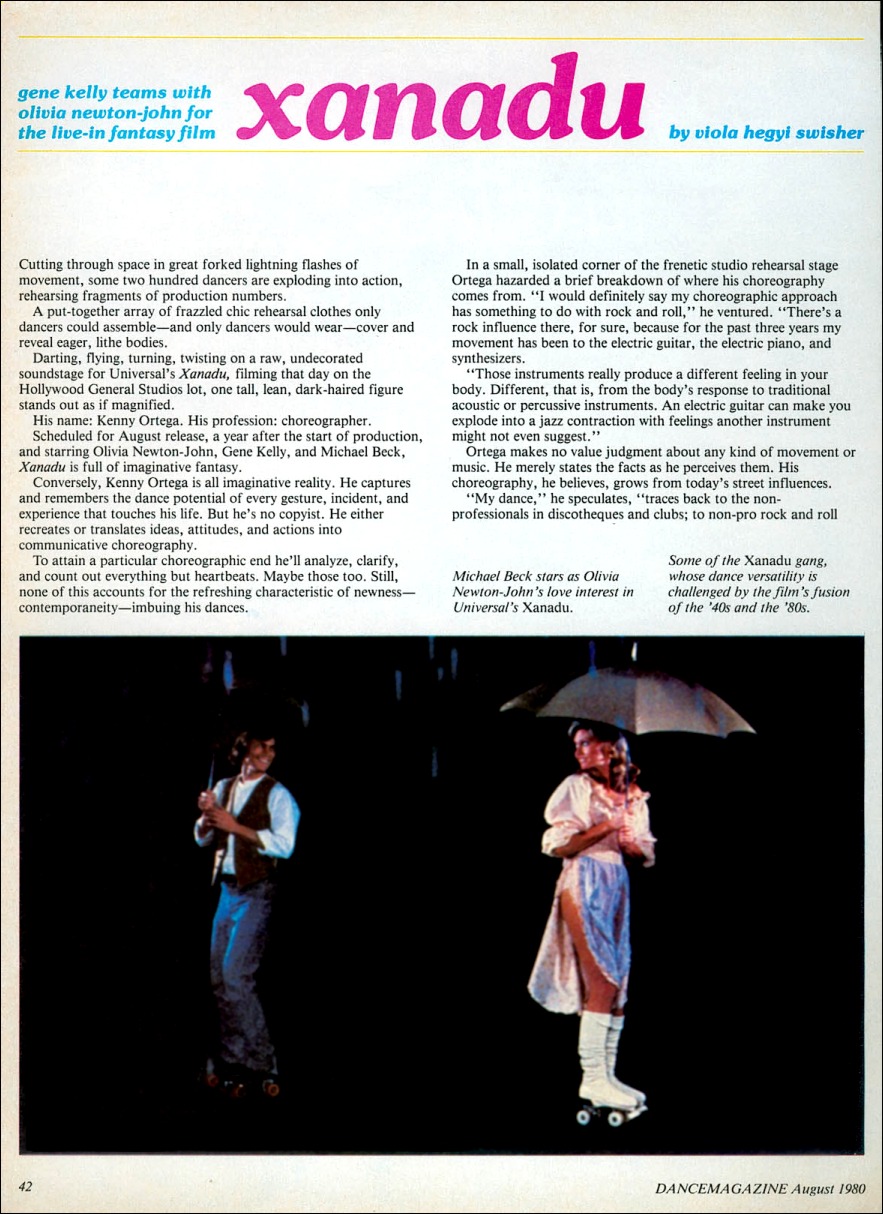
Film Fantasy Xanadu
Cutting through space in great forked lightning flashes of movement, some two hundred dancers are exploding into action, rehearsing fragments of production numbers. A put-together array of frazzled chic rehearsal clothes only dancers could assemble and only dancers would wear-cover and reveal eager, lithe bodies.
Darting, flying, turning, twisting on a raw, undecorated soundstage for Universal’s Xanadu, filming that day on the Hollywood General Studios lot, one tall, lean, dark-haired figure stands out as if magnified.
His name: Kenny Ortega. His profession: choreographer. Scheduled for August release, a year after the start of production, and starring Olivia Newton-John, Gene Kelly, and Michael Beck, Xanadu is full of imaginative fantasy.
Conversely, Kenny Ortega is all imaginative reality. He captures and remembers the dance potential of every gesture, incident, and experience that touches his life. But he’s no copyist. He either recreates or translates ideas, attitudes, and actions into communicative choreography.
To attain a particular choreographic end he’ll analyze, clarify, and count out everything but heartbeats. Maybe those too. Still, none of this accounts for the refreshing characteristic of newness-contemporaneity-imbuing his dances.
In a small, isolated corner of the frenetic studio rehearsal stage Ortega hazarded a brief breakdown of where his choreography comes from. “I would definitely say my choreographic approach has something to do with rock and roll,” he ventured. “There’s a rock influence there, for sure, because for the past three years my movement has been to the electric guitar, the electric piano, and synthesizers.”
“Those instruments really produce a different feeling in your body. Different, that is, from the body’s response to traditional acoustic or percussive instruments. An electric guitar can make you explode into a jazz contraction with feelings another instrument might not even suggest.”
Ortega makes no value judgment about any kind of movement or music. He merely states the facts as he perceives them. His choreography, he believes, grows from today’s street influences.
“My dance,” he speculates, “traces back to the non-professionals in discotheques and clubs; to non-pro rock and roll dancers who now are ‘moving off of a new kind of music. It fiddles along with the lead guitar. It does riffs. You know how the guitar goes ti-da-da di-de-da da-da-da-day. It’s like a tap dancer does his riffs. My dancers and I - instead of just moving to that musical riff tempo and snapping our fingers in a regular metronomic beat - create our own phrases. Our own riffs. Body riffs.”
Ortega must have been doing a lot of right things to get Xanadu in which to create his first film choreography. “Everybody’s been so great to work with,” he said some days later when the company was on location at Fiorucci’s Beverly Hills boutique, converted into a movie set. “It’s wonderful to choreograph for a choreographer - especially if he happens to be Gene Kelly. Working with Gene is the most ultimate experience I’ve ever had in my career. Of course he has his own ideas for what he does in Xanadu, but he’s always attentive to my ideas too. He’s made me feel-well-respected.”
Gene Kelly on roller skates at the Fiorucci location is as superlatively smooth and commanding an artist as Kelly in his dancing shoes. Or any other gear, for that matter. Rollering around racks of bright-hued clothes, he’s imperturbable in his role of a rich man who implements young Michael Beck’s dreams. And when the clothes racks, manipulated by hidden roller-skating specialists, start dancing back at Gene, Ortega creates a new style of fantasy land, with skating dancers wheeling out of their clothes-rack closets in geometric pattern.
Just before signaling the break for lunch, Xanadu director Robert Greenwald, originally a man of the legitimate theater (it’s his first major motion picture too), said, “For me the key to this film is a matter of getting the pictures that are in my mind, out of my mind - and onto the screen.”
Xanadu’s other choreographer, Jerry Trent, is a romantic dance composer. His innate lyricism shows up immediately. Viewed on the set, Trent’s choreography is a love song alive with stylish amour for encounters of a very sexy kind.
Trent started out working on Olivia Newton-John and Michael Beck’s numbers. Now Beck is no trained dancer, though, as an athletic specimen, he’s a “good mover.” Says he, “I like other arts besides acting even if I don’t perform in them. And I do a lot of things just for fun, but. .” It doesn’t take long to discover that he has more fun as an observer than as a participant of dance. One of the things Trent led him into was performing on the flying rings. To music.
Trent then went ahead to develop the platform dances for Newton-John’s Terpsichore character and the other eight muses of Greek mythology. Xanadu muses are not confined to wafting around exclusively in recital-type floaty chiffons. Director Greenwald shot the chic deities’ platform numbers in contexts and costumes quite alien to their ancient Greek origins. In one number they wear ’40s-style shorts, sweep their hair into updo coiffures à la Betty Grable, and tap their little feet off. For a cowgirl bit, costume designer Bobbie Mannix gave them swinging fringes, twirling lariats, and confetti to shoot out of their guns.
Trent began choreographing when he felt he had outgrown his profession of dancer. He liked, of course, to do things that looked good on him. “But as a choreographer I won’t give a dancer something just because I like it or it would look good on me,” he declared. “I realized from the start that if an action doesn’t look good on my dancers, it’s not going to be good for me. Xanadu is the first major film I’ve choreographed and from it I’ve learned that for all the camera’s ability to see some things your human eyes don’t see, you as choreographer have to remember that the camera doesn’t have any mind at all - except yours.”
Both Ortega and Trent join in hallelujahs for Gene Kelly’s generous encouragement, “Dance was my first love and it’s still my number one love,” said Kelly. “In the ’30s I was striving to invent a style of my own. At times I thought nobody would buy it, but I kept developing my own particular style anyhow.”
Kelly hesitates to call dancers more or less masochistic. “Yet,” he contends, “you can’t walk in every day and train for a heavyweight fight - and not know whether you’re going to get in the ring or not. In effect, that’s what a dancer does. He can’t ever tell if he’s going to get a job. All he knows is that he has to keep in shape.”
“Every dancer doesn’t necessarily have it within him to become a choreographer. That’s a very specialized talent. Talent is something that can’t be taught. Lord knows, though, they’ve tried it! No. You pull dance out of thin air. Right out of thin air.”
Out of thin air, too, were pulled the creative energies of Xanadu producers Lawrence Gordon and Lee Kramer; the Richard Christian Danus-Michael Kane-Marc Reid Rubel script; the song writing of Jeff Lynne and John Farrar, the contributions of other artists and artisans, named and unnamed - and movie magic itself.
Viewed live on a soundstage back at Universal Studios, one of the most spectacular sequences Ortega pulled out of the air focuses on a fusion of the ’40s and ’80s in dance and music. On a tiered white Art Deco stage within the soundstage, a dinner-jacketed big band gives musical motivation to the dancers. Theirs is no chorus line. They represent individual identifiable characters: a French pair in a bone-breaking apache fragment, a banana republic hip-shaker. Whatever.
In separate eight-bar segments, the ’40s group is shot to accommodate camera cuts. Cut and pick up, cut and pick up, again and yet again. All the while, the dancers have to project for future film theater audiences the illusion of an uninterrupted crescendo flow of movement. Then, when the ’40s dissolve into the ’80s-the dancers physically enmeshed with the music-mad Tubes it’s climax time in Xanadu.
Trent’s dance background encompasses assisting Michael Kidd, Onna White, Mark Breaux. Born in Danville, Illinois, he studied tap and acrobatic techniques at seven and soon went into ballet and jazz classes. At fifteen he was doing ten community theater shows in ten weeks in his native state. Next came nightclubs in Chicago, bolstered by some modeling. He danced in New York musical theater and television, married dancer Audrey Hay. After the birth of their son Chris, the Trents moved to Los Angeles where Jerry danced in films and TV before concentrating all his professional time on choreography.
Kenny Ortega, too, was an early starter in the world of dance. Born in Redwood City, California, he impartially applied himself to tap, jazz, ballet, acrobatics, and flamenco dance studies at the age of four and began a professional career in his early teens. He has appeared in, choreographed, and directed enough musical theater to qualify as an expert, and has even written and produced a show of his own. Among career highlights are his exposure in Hair, his work with The Tubes; The Mystic Knights of the Oingo Boingo; with Toni Basil, Bette Midler, Cher, Kiss, and Ethel Merman.
This spring he choreographed Olivia Newton-John’s ABC-TV special. His guest at the Xanadu wrap party was Cher, he in black tie (silver, really), she in shiny jet, glitter, and black leather.
A few years before the eighteenth century expired, English poet-philosopher Samuel Taylor Coleridge (who had a drug problem) wrote a romantic poem about Kubla Khan building a pleasure-dome, Xanadu. This was a sunny place with caves of ice, a dulcimer-playing Abyssinian maid, incense-bearing trees, and intoxicating milk of paradise.
Universal’s Xanadu is nothing like that. Its fantasies are of and for today’s people. Its director, producers, stars, choreographers, dancers, and musicians have made it a trip. A rare place to visit. And there are those who might even want to live there!