
Creating Unique Special Effects for Xanadu
80sthanks to Kay
Click to enlarge. Vol 61, no 8
By R. Greenberg
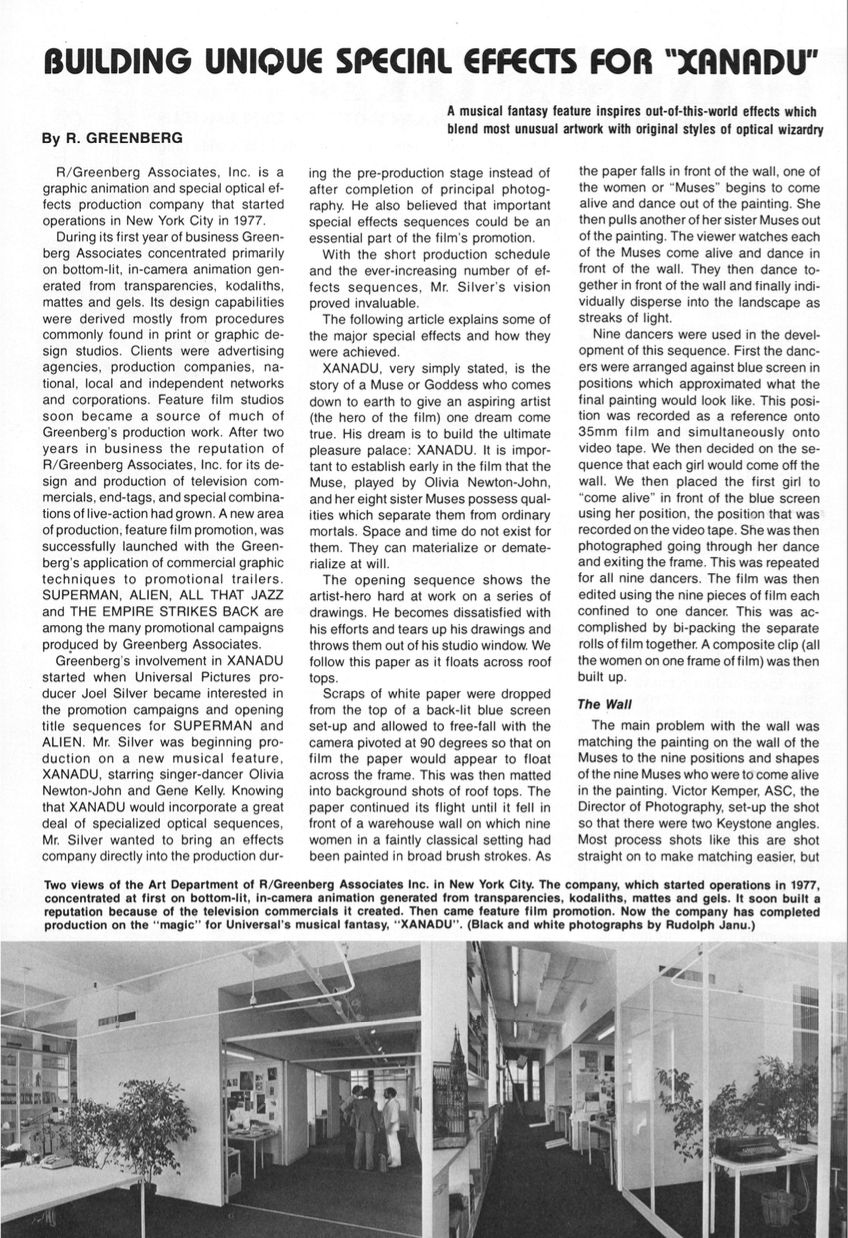
R/Greenberg Associates, Inc. is a graphic animation and special optical effects production company that started operations in New York City in 1977.
During its first year of business Greenberg Associates concentrated primarily on bottom-lit, in-camera animation generated from transparencies, kodaliths, mattes and gels. Its design capabilities were derived mostly from procedures commonly found in print or graphic design studios. Clients were advertising agencies, production companies, national, local and independent networks and corporations. Feature film studios soon became a source of much of Greenberg's production work.
After two years in business the reputation of R/Greenberg Associates, Inc. for its design and production of television commercials, end-tags, and special combinations of live-action had grown. A new area of production, feature film promotion, was successfully launched with the Green-berg's application of commercial graphic techniques to promotional trailers. SUPERMAN, ALIEN, ALL THAT JAZZ and THE EMPIRE STRIKES BACK are among the many promotional campaigns produced by Greenberg Associates.
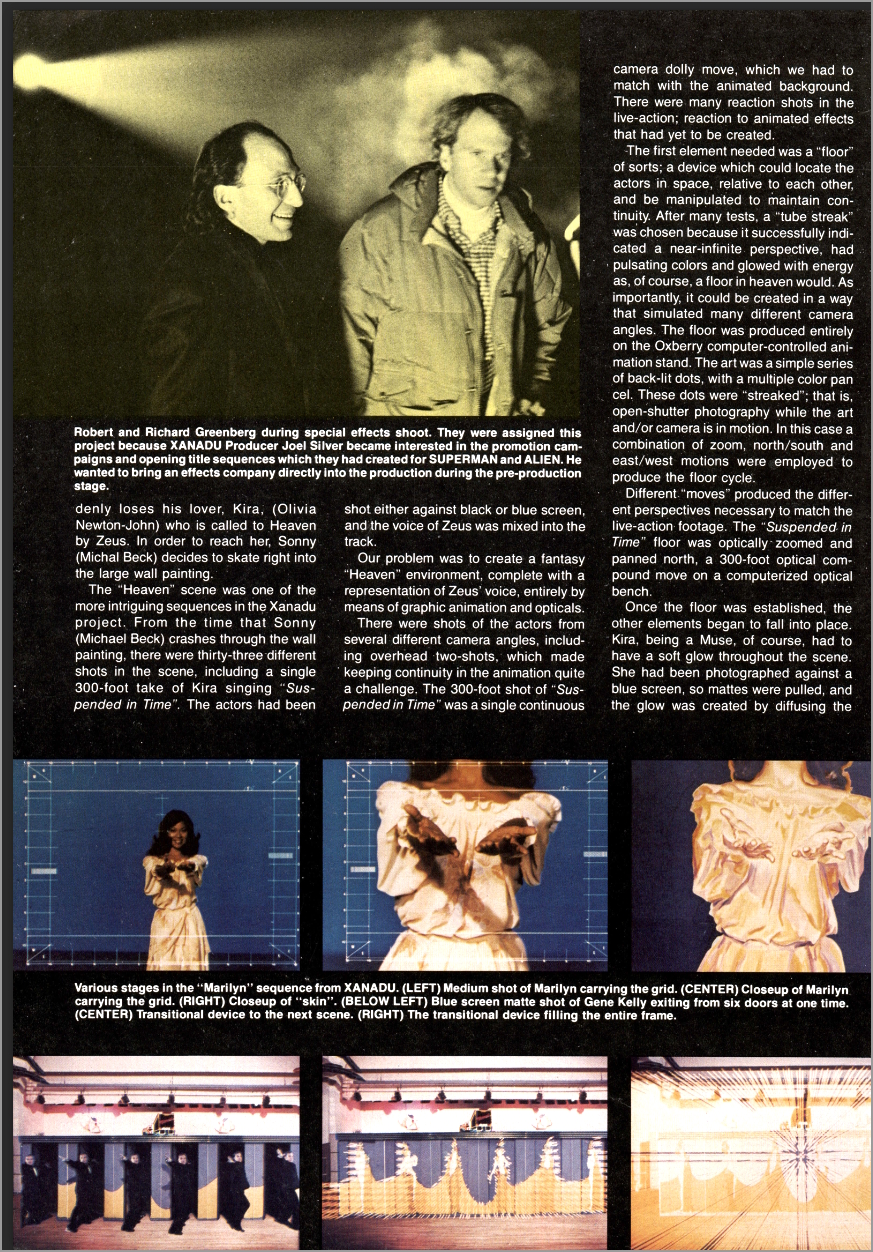
Greenberg's involvement in XANADU started when Universal Pictures producer Joel Silver became interested in the promotion campaigns and opening title sequences for SUPERMAN and ALIEN. Mr. Silver was beginning production on a new musical feature, XANADU, starring singer-dancer Olivia Newton-John and Gene Kelly. Knowing that XANADU would incorporate a great deal of specialized optical sequences, Mr. Silver wanted to bring an effects company directly into the production during the pre-production stage instead of after completion of principal photography. He also believed that important special effects sequences could be an essential part of the film's promotion.
With the short production schedule and the ever-increasing number of effects sequences, Mr. Silver's vision proved invaluable.
The following article explains some of the major special effects and how they were achieved.
XANADU, very simply stated, is the story of a Muse or Goddess who comes down to earth to give an aspiring artist (the hero of the film) one dream come true. His dream is to build the ultimate pleasure palace: XANADU. It is important to establish early in the film that the Muse, played by Olivia Newton-John, and her eight sister Muses possess qualities which separate them from ordinary mortals. Space and time do not exist for them. They can materialize or dematerialize at will.
The opening sequence shows the artist-hero hard at work on a series of drawings. He becomes dissatisfied with his efforts and tears up his drawings and throws them out of his studio window. We follow this paper as it floats across roof tops.
Scraps of white paper were dropped from the top of a back-lit blue screen set-up and allowed to free-fall with the camera pivoted at 90 degrees so that on film the paper would appear to float across the frame. This was then matted into background shots of roof tops. The paper continued its flight until it fell in front of a warehouse wall on which nine women in a faintly classical setting had been painted in broad brush strokes. As the paper falls in front of the wall, one of the women or Muses
begins to come alive and dance out of the painting. She then pulls another of her sister Muses out of the painting. The viewer watches each of the Muses come alive and dance in front of the wall. They then dance together in front of the wall and finally individually disperse into the landscape as streaks of light.
Nine dancers were used in the development of this sequence. First the dancers were arranged against blue screen in positions which approximated what the final painting would look like. This position was recorded as a reference onto 35mm film and simultaneously onto video tape. We then decided on the sequence that each girl would come off the wall. We then placed the first girl to come alive
in front of the blue screen using her position, the position that was recorded on the video tape. She was then photographed going through her dance and exiting the frame. This was repeated for all nine dancers. The film was then edited using the nine pieces of film each confined to one dancer. This was accomplished by bi-packing the separate rolls of film together. A composite clip (all the women on one frame of film) was then built up.
The Wall
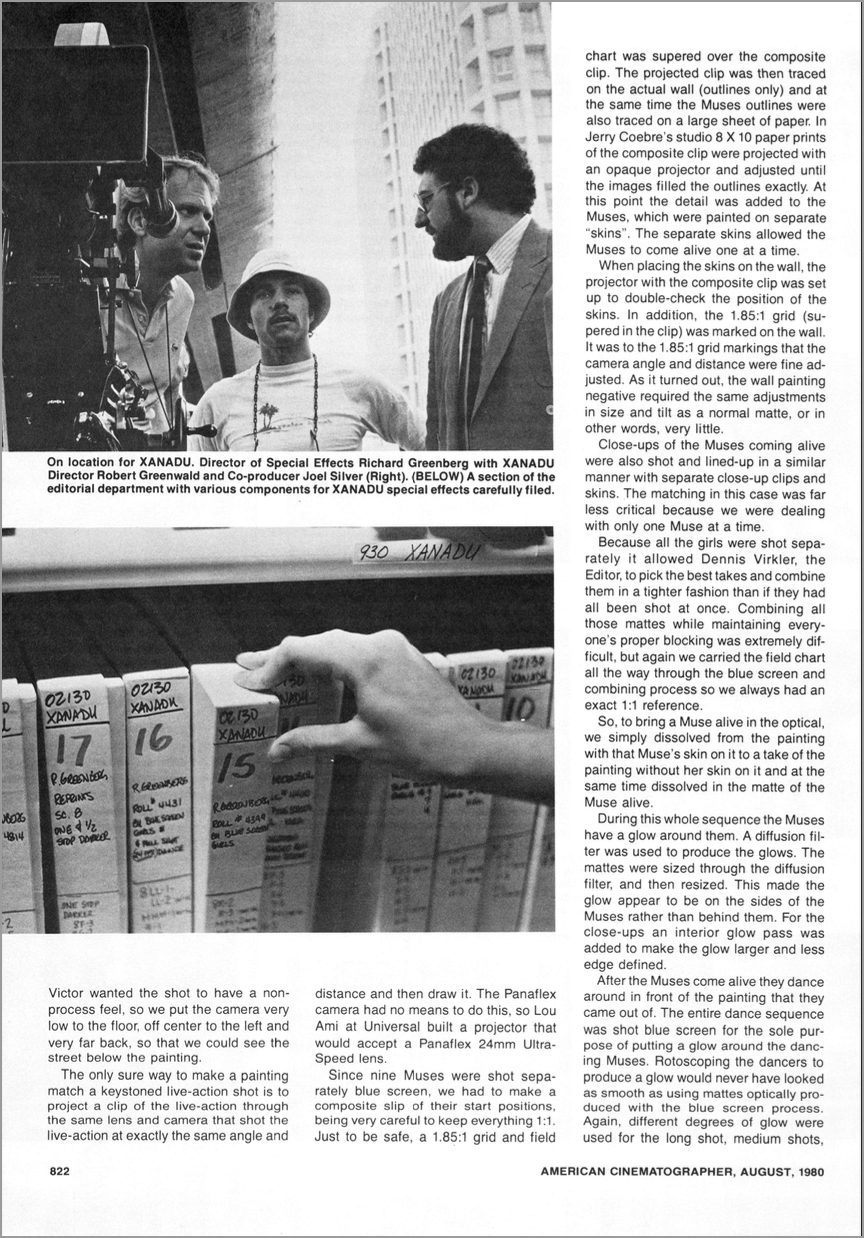
The main problem with the wall was matching the painting on the wall of the Muses to the nine positions and shapes of the nine Muses who were to come alive in the painting. Victor Kemper, ASC, the Director of Photography, set-up the shot so that there were two Keystone angles. Most process shots like this are shot straight on to make matching easier, but Victor wanted the shot to have a non-process feel, so we put the camera very low to the floor, off center to the left and very far back, so that we could see the street below the painting.
The only sure way to make a painting match a keystoned live-action shot is to project a clip of the live-action through the same lens and camera that shot the live-action at exactly the same angle and distance and then draw it. The Panaflex camera had no means to do this, so Lou Ami at Universal built a projector that would accept a Panaflex 24mm Ultra-Speed lens.
Since nine Muses were shot separately blue screen, we had to make a composite slip of their start positions, being very careful to keep everything 1:1. Just to be safe, a 1.85:1 grid and field chart was supered over the composite clip. The projected clip was then traced on the actual wall (outlines only) and at the same time the Muses outlines were also traced on a large sheet of paper. In Jerry Coebre's studio 8 X 10 paper prints of the composite clip were projected with an opaque projector and adjusted until the images filled the outlines exactly. At this point the detail was added to the Muses, which were painted on separate skins
. The separate skins allowed the Muses to come alive one at a time.
When placing the skins on the wall, the projector with the composite clip was set up to double-check the position of the skins. In addition, the 1.85:1 grid (supered in the clip) was marked on the wall. It was to the 1.85:1 grid markings that the camera angle and distance were fine adjusted. As it turned out, the wall painting negative required the same adjustments in size and tilt as a normal matte, or in other words, very little.
Close-ups of the Muses coming alive were also shot and lined-up in a similar manner with separate close-up clips and skins. The matching in this case was far less critical because we were dealing with only one Muse at a time.
Because all the girls were shot separately it allowed Dennis Virkler, the Editor, to pick the best takes and combine them in a tighter fashion than if they had all been shot at once. Combining all those mattes while maintaining everyone's proper blocking was extremely difficult, but again we carried the field chart all the way through the blue screen and combining process so we always had an exact 1:1 reference.
So, to bring a Muse alive in the optical, we simply dissolved from the painting with that Muse's skin on it to a take of the painting without her skin on it and at the same time dissolved in the matte of the Muse alive.
During this whole sequence the Muses have a glow around them. A diffusion filter was used to produce the glows. The mattes were sized through the diffusion filter, and then resized. This made the glow appear to be on the sides of the Muses rather than behind them. For the close-ups an interior glow pass was added to make the glow larger and less edge defined.
After the Muses come alive they dance around in front of the painting that they came out of. The entire dance sequence was shot blue screen for the sole purpose of putting a glow around the dancing Muses. Rotoscoping the dancers to produce a glow would never have looked as smooth as using mattes optically produced with the blue screen process. Again, different degrees of glow were used for the long shot, medium shots, and close-ups.
All the mattes in the dance sequence were carried slightly soft. The field charts on each take allowed us to size the mattes to 1:1 even though they were out of focus. Soft edge mattes helped the glow blend with the dancers and also made the shadows of the dancers, which were picked up in the blue screen process, soft, as they would be in reality. The shadows, normally something to be avoided in blue screen, were intentionally emphasized. They added another frame of reference and made the Muses seem like they are really part of the scene.
After the wall dance, the Muses run all over the city turning into streaks of light. For this a digitized zoom controller (built by Optical Director, Joel Hynek) was used to make time-exposed zooms of the matte elements produced optically for the live-action. The streak sources were produced either through the blue screen process (if they were shot blue screen) or through whatever type of separation process that worked the best with any given shot.
All the streaks were given tapers; that is, on any one single frame the head of the streak would be very bright with its tail tapering down to nothing. much like a comet tail. Because the streak sources were produced from the live-action itself, its motion became that of the live-action. It turned out to be a very effective method for combining a graphic element with live-action.
As the film continues there is a scene in which an old auditorium had to be transformed into the hero's dream pal-ace, Xanadu. The building was chosen because of its unique architecture.
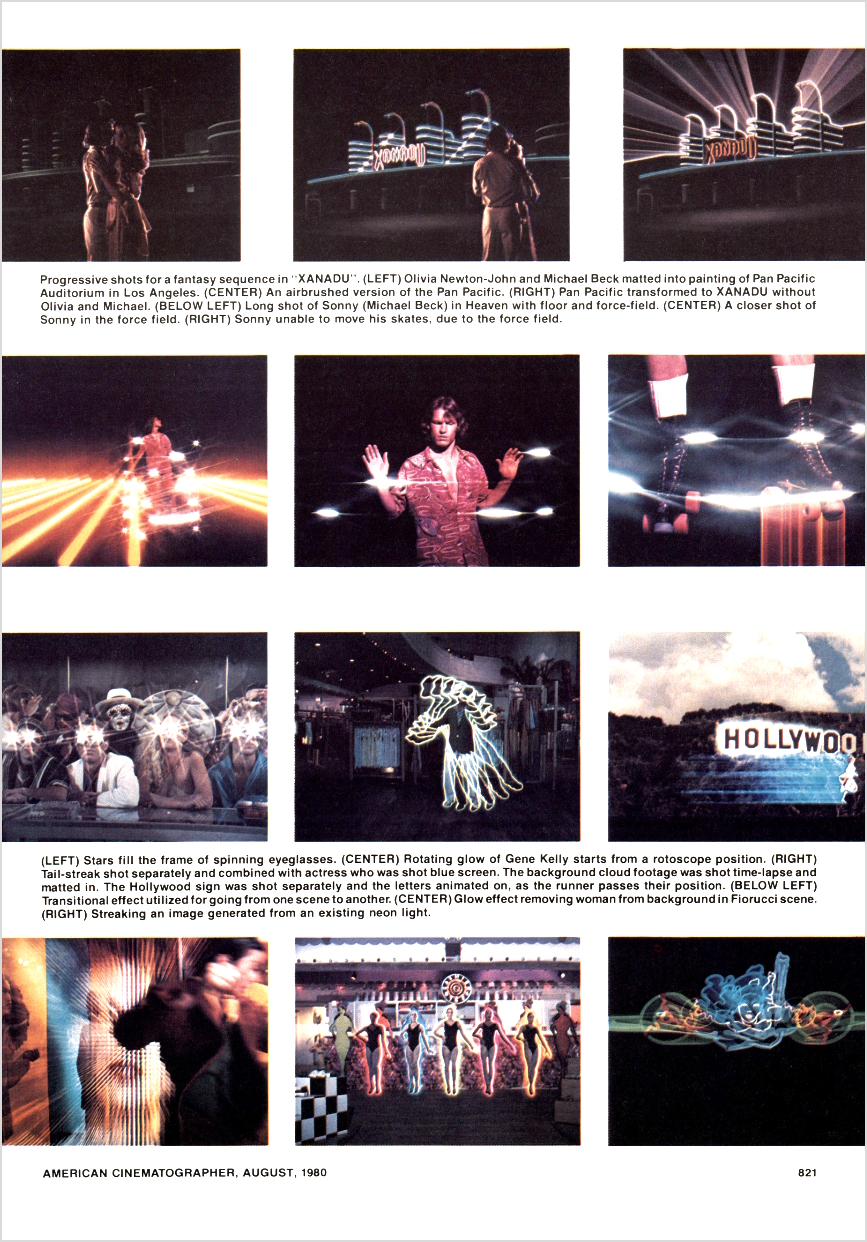
Footage was shot of the Pan Pacific Auditorium with a locked-down camera. From a negative clip a frame was blown up and a large color paper print was made. It was airbrushed and rendered with additional sections of the building that did not exist before. An 8 X 10 chrome was made of the newly re-designed building. Selected sections were separated from the chrome via handmade mattes and separation Kodalith negatives and positives to form a neon light architecture. The actors were shot at the same camera angle as the building, but on a blue screen process. They were then matted in optically and danced across the screen while the transformation took place from the old building to the new structure.
The Muses were constantly disappearing throughout the film. Therefore, we had to develop different methods of removing the women from the scene. Following is a description of one way which did not need to employ blue screen:
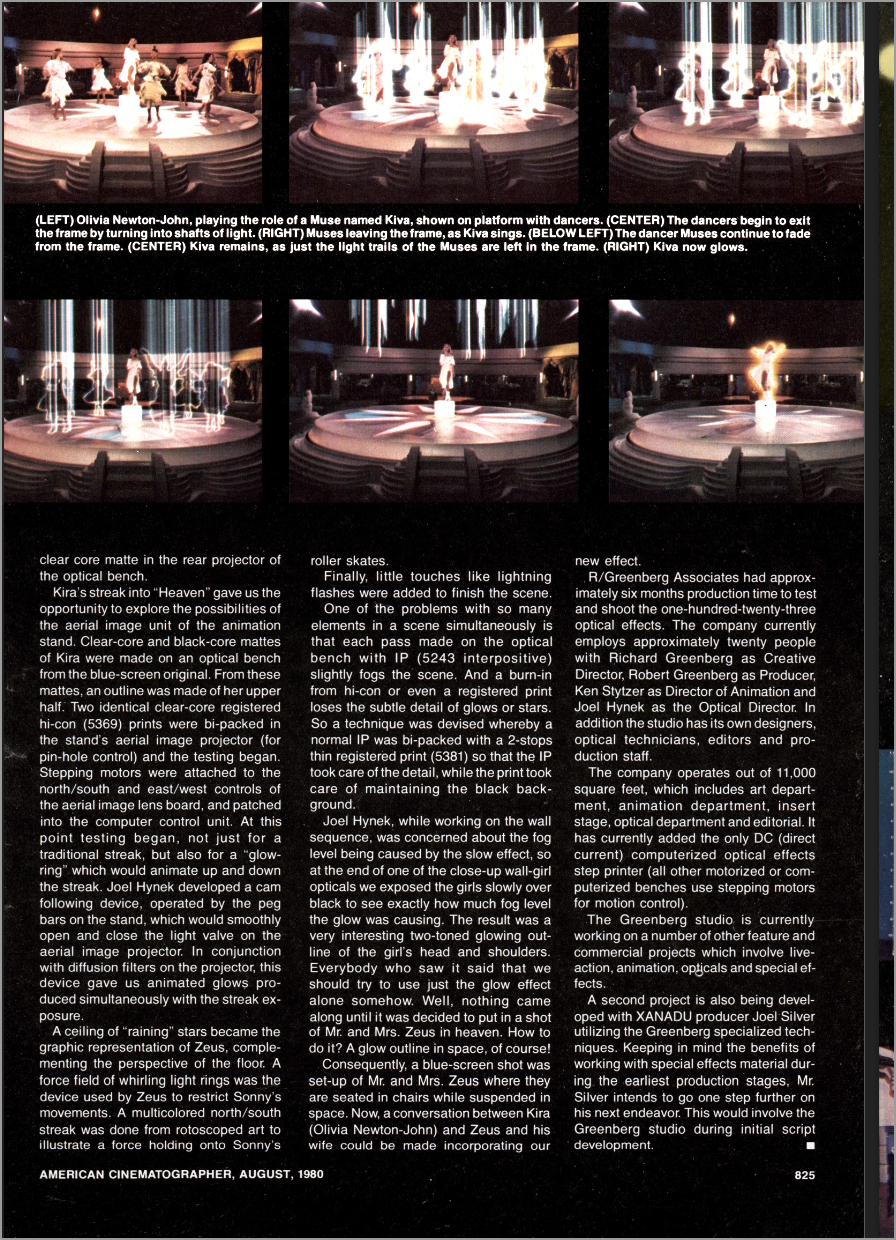
Dancers were situated on a huge revolving platform with a floor that was changing colors in a kaleidoscopic pattern. Olivia Newton-John was positioned in the middle of all this and was the motivation of the transformation effect. She first starts to sparkle and beams of streaked light shoot from her towards the viewer. A soft edge traveling matte is used to reveal the Muses while the beams of light lift upward. The Muses, including Kira, are now revealed. The next problem is how to remove them completely.
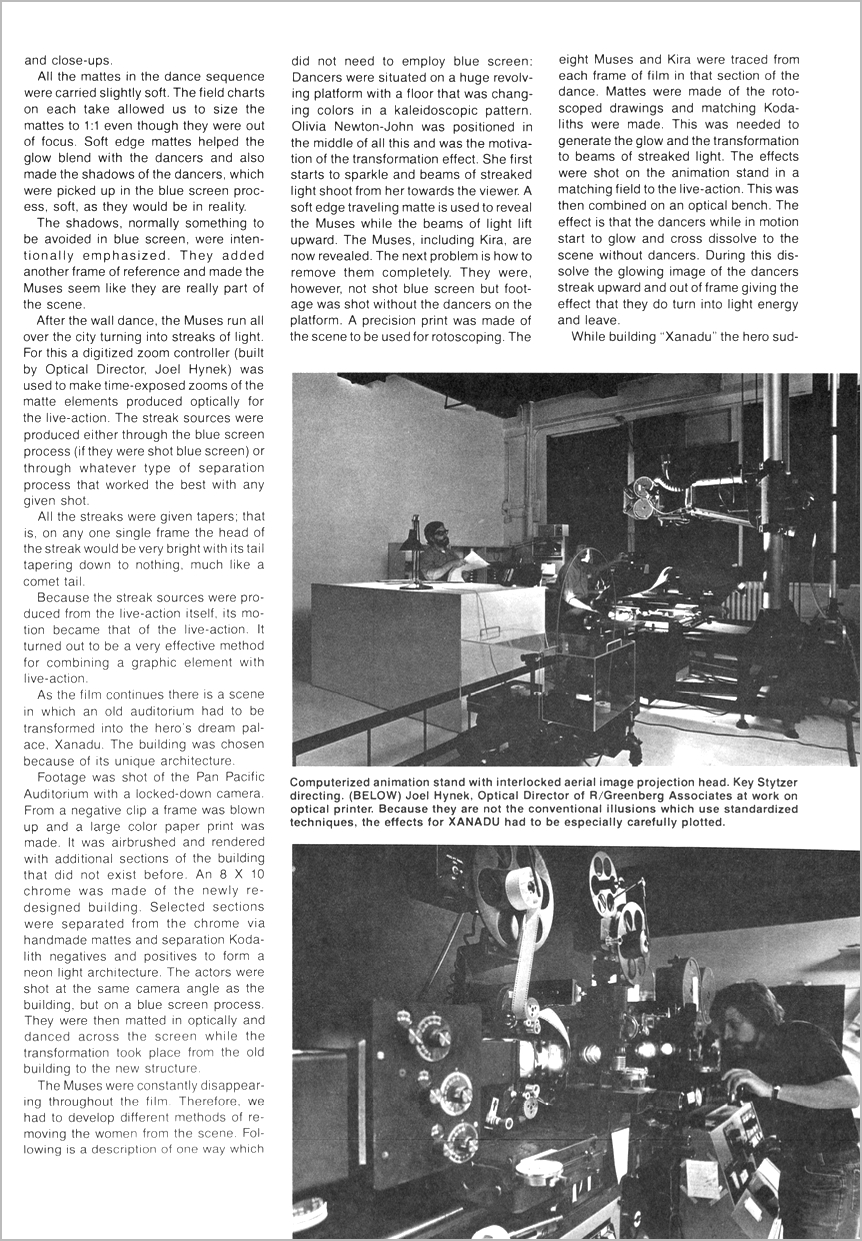
They were, however, not shot blue screen but footage was shot without the dancers on the platform. A precision print was made of the scene to be used for rotoscoping. The eight Muses and Kira were traced from each frame of film in that section of the dance. Mattes were made of the rotoscoped drawings and matching Kodaliths were made. This was needed to generate the glow and the transformation to beams of streaked light. The effects were shot on the animation stand in a matching field to the live-action. This was then combined on an optical bench. The effect is that the dancers while in motion start to glow and cross dissolve to the scene without dancers. During this dissolve the glowing image of the dancers streak upward and out of frame giving the effect that they do turn into light energy and leave.
While building Xanadu
the hero suddenly loses his lover, Kira, (Olivia Newton-John) who is called to Heaven by Zeus. In order to reach her, Sonny (Michael Beck) decides to skate right into the large wall painting.
The Heaven
scene was one of the more intriguing sequences in the Xanadu project. From the time that Sonny (Michael Beck) crashes through the wall painting, there were thirty-three different shots in the scene, including a single 300-foot take of Kira singing Suspended in Time
. The actors had been shot either against black or blue screen, and the voice of Zeus was mixed into the track.
Our problem was to create a fantasy Heaven
environment, complete with a representation of Zeus' voice, entirely by means of graphic animation and opticals.
There were shots of the actors from several different camera angles, including overhead two-shots, which made keeping continuity in the animation quite a challenge. The 300-foot shot of Suspended in Time
was a single continuous camera dolly move, which we had to match with the animated background. There were many reaction shots in the live-action; reaction to animated effects that had yet to be created.
The first element needed was a floor
of sorts; a device which could locate the actors in space, relative to each other, and be manipulated to maintain continuity. After many tests, a tube streak
was chosen because it successfully indicated a near-infinite perspective, had pulsating colors and glowed with energy as, of course, a floor in heaven would. As importantly, it could be created in a way that simulated many different camera angles. The floor was produced entirely on the Oxberry computer-controlled animation stand. The art was a simple series of back-lit dots, with a multiple color pancel. These dots were streaked
; that is, open-shutter photography while the art and/or camera is in motion. In this case a combination of zoom, north/south and east/west motions were employed to produce the floor cycle.
Different. moves
produced the different perspectives necessary to match the live-action footage. The Suspended in Time
floor was optically zoomed and panned north, a 300-foot optical compound move on a computerized optical bench.
Once the floor was established, the other elements began to fall into place. Kira, being a Muse, of course, had to have a soft glow throughout the scene. She had been photographed against a blue screen, so mattes were pulled, and the glow was created by diffusing the clear core matte in the rear projector of the optical bench.
Kira's streak into Heaven
gave us the opportunity to explore the possibilities of the aerial image unit of the animation stand. Clear-core and black-core mattes of Kira were made on an optical bench from the blue-screen original. From these mattes, an outline was made of her upper half. Two identical clear-core registered hi-con (5369) prints were bi-packed in the stand's aerial image projector (for pin-hole control) and the testing began. Stepping motors were attached to the north/south and east/west controls of the aerial image lens board, and patched into the computer control unit.
At this point testing began, not just for a traditional streak, but also for a glow-ring
which would animate up and down the streak. Joel Hynek developed a cam following device, operated by the peg bars on the stand, which would smoothly open and close the light valve on the aerial image projector. In conjunction with diffusion filters on the projector, this device gave us animated glows produced simultaneously with the streak exposure.
A ceiling of raining
stars became the graphic representation of Zeus, complementing the perspective of the floor. A force field of whirling light rings was the device used by Zeus to restrict Sonny's movements. A multicolored north/south streak was done from rotoscoped art to illustrate a force holding onto Sonny's roller skates.
Finally, little touches like lightning flashes were added to finish the scene. One of the problems with so many elements in a scene simultaneously is that each pass made on the optical bench with IP (5243 interpositive) slightly fogs the scene. And a burn-in from hi-con or even a registered print loses the subtle detail of glows or stars. So a technique was devised whereby a normal IP was bi-packed with a 2-stops thin registered print (5381) so that the IP took care of the detail, while the print took care of maintaining the black background.
Joel Hynek, while working on the wall sequence, was concerned about the fog level being caused by the slow effect, so at the end of one of the close-up wall-girl opticals we exposed the girls slowly over black to see exactly how much fog level the glow was causing. The result was a very interesting two-toned glowing out-line of the girl's head and shoulders. Everybody who saw it said that we should try to use just the glow effect alone somehow. Well, nothing came along until it was decided to put in a shot of Mr. and Mrs. Zeus in heaven. How to do it? A glow outline in space, of course!
Consequently, a blue-screen shot was set-up of Mr. and Mrs. Zeus where they are seated in chairs while suspended in space. Now, a conversation between Kira (Olivia Newton-John) and Zeus and his wife could be made incorporating our new effect.
R/Greenberg Associates had approximately six months production time to test and shoot the one-hundred-twenty-three optical effects. The company currently employs approximately twenty people with Richard Greenberg as Creative Director, Robert Greenberg as Producer, Ken Stytzer as Director of Animation and Joel Hynek as the Optical Director. In addition the studio has its own designers, optical technicians, editors and production staff.
The company operates out of 11,000 square feet, which includes art department, animation department, insert stage, optical department and editorial. It has currently added the only DC (direct current) computerized optical effects step printer (all other motorized or com-puterized benches use stepping motors for motion control).
The Greenberg studio is currently working on a number of other feature and commercial projects which involve live-action, animation, opticals and special effects.
A second project is also being developed with XANADU producer Joel Silver utilizing the Greenberg specialized techniques. Keeping in mind the benefits of working with special effects material during the earliest production stages, Mr. Silver intends to go one step further on his next endeavor. This would involve the Greenberg studio during initial script development.