
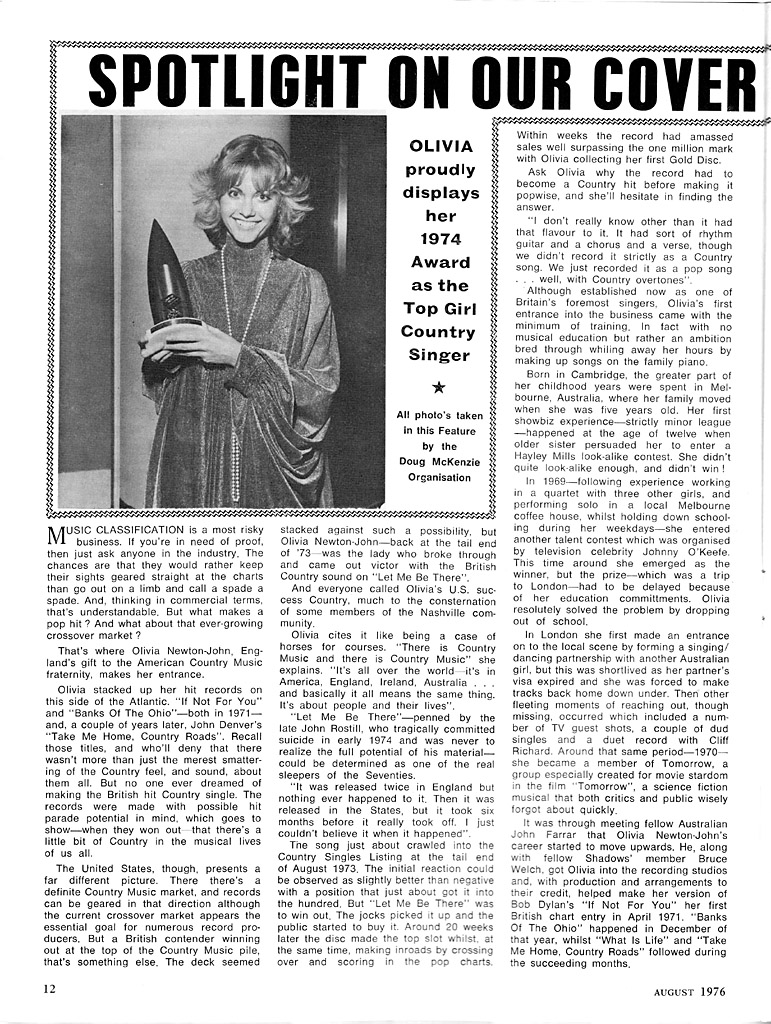
Spotlight on cover star Olivia
CLASSIFICATION is most risky business. If you’re in need of proof, then just ask anyone in the industry. The chances are that they would rather keep their sights geared straight at the charts than go out on a limb and call a spade a spade. And, thinking in commercial terms. that’s understandable, But what makes a pop hit? And what about that ever-growing crossover market?
That’s where Olivia Newton-John, England’s gift to the American Country Music fraternity, makes her entrance.
Olivia stacked up her hit records on this side of the Atlantic. “If Not For You” and “Banks Of The Ohio” - both in 1971-and, a couple of years later, John Denver’s “Take Me Home, Country Roads”. Recall those titles, and who’ll deny that there wasn’t more than just the merest smattering of the Country feel, and sound, about them all. But no one ever dreamed of making the British hit Country single. The records were made with possible hit parade potential in mind, which goes to show - when they won out that there’s a little bit of Country in the musical lives of us all.
The United States, though, presents a far different picture. There there’s a definite Country Music market, and records can be geared in that direction although the current crossover market appears the essential goal for numerous record producers. But a British contender winning out at the top of the Country Music pile, that’s something else. The deck seemed stacked against such a possibility, but Olivia Newton-John-back at the tail end of ‘73 was the lady who broke through and came out victor with the British Country sound on “Let Me Be There”.
And everyone called Olivia’s U.S. success Country, much to the consternation of some members of the Nashville community.
Olivia cites it like being a case of horses for courses. “There is Country Music and there is Country Music” she explains. “It’s all over the world it’s in America, England, Ireland, Australia and basically it all means the same thing. It’s about people and their lives”.
“Let Me Be There” - penned by the late John Rostill, who tragically committed suicide in early 1974 and was never to realize the full potential of his material-could be determined as one of the real sleepers of the Seventies.
“It was released twice in England but nothing ever happened to it. Then it was released in the States, but it took six months before it really took off. I just couldn’t believe it when it happened”.
The song just about crawled into the Country Singles Listing at the tail end of August 1973. The initial reaction could be observed as slightly better than negative with a position that just about got it into the hundred. But “Let Me Be There” was to win out. The jocks picked it up and the public started to buy it. Around 20 weeks later the disc made the top slot whilst, at the same time, making inroads by crossing over and scoring in the pop charts.
Within weeks the record had amassed sales well surpassing the one million mark with Olivia collecting her first Gold Disc.
Ask Olivia why the record had to become a Country hit before making it pop-wise, and she’ll hesitate in finding the answer.
“I don’t really know other than it had that flavour to it. It had sort of rhythm guitar and a chorus and a verse, though we didn’t record it strictly as a Country song. We just recorded it as a pop song well, with Country overtones”.
Although established now as one of Britain’s foremost singers, Olivia’s first entrance into the business came with the minimum of training, In fact with no musical education but rather an ambition bred through whiling away her hours by making up songs on the family piano.
Born in Cambridge, the greater part of her childhood years were spent in Melbourne, Australia, where her family moved when she was five years old. Her first showbiz experience strictly minor league - happened at the age of twelve when older sister persuaded her to enter a Hayley Mills look-alike contest. She didn’t quite look-alike enough, and didn’t win!
In 1969-following experience working in a quartet with three other girls, and performing solo in a local Melbourne coffee house, whilst holding down schooling during her weekdays - she entered another talent contest which was organised by television celebrity Johnny O’Keefe. This time around she emerged as the winner, but the prize - which was a trip to London - had to be delayed because of her education commitments. Olivia resolutely solved the problem by dropping out of school.
In London she first made an entrance on to the local scene by forming a singing/dancing partnership with another Australian girl, but this was short lived as her partner’s visa expired and she was forced to make tracks back home down under. Then other fleeting moments of reaching out, though missing, occurred which included a number of TV guest shots, a couple of dud singles and a duet record with Cliff Richard. Around that same period - 1970 - she became a member of Toomorrow, a group especially created for movie stardom in the film “Tomorrow”, a science fiction musical that both critics and public wisely forgot about quickly.
It was through meeting fellow Australian John Farrar that Olivia Newton-John’s career started to move upwards. He, along with fellow Shadows member Bruce Welch, got Olivia into the recording studios and, with production and arrangements to their credit, helped make her version of Bob Dylan’s “If Not For You” her first British chart entry in April 1971. “Banks Of The Ohio” happened in December of that year, whilst “What Is Life” and “Take Me Home, Country Roads” followed during the succeeding months.
And then she clicked in the United States…
But, even with a million-plus sales to its credit, “Let Me Be There” still wasn’t finished in its run of success. The album of the same title, which consisted of repackaged earlier British recordings. entered the charts in January 1974 - but this time the climb to the top was far quicker. Eight weeks later it was number one. The song itself paved the way for Olivia to reach the greater heights of U.S. stardom and she made it a double triumph by not only collecting a Grammy for the Best Country Female Vocal but also an Award from the West Coast Academy of Country Music as the Most Promising Female Vocalist. And that was just for starters.
“If You Love Me (Let Me Know)” - another John Rostill song was chosen as the follow-up single to “Let Me Be There”, and the pattern of events was predictable. It went to the top and went gold (as did the album of the same name), and proved emphatically that you didn’t have to be American to sell Country Music to the Americans.
“I’ve been asked that quite a few times, by people in the States who wanted to know how you record a Country record in Britain” she says. “I guess there’s no answer other than it resting with the studio and musicians.”
“John Farrar, who produces all my recordings, is a great Country fan and that helps considerably. He frequently tries to duplicate the sounds he hears on his favourite Country records. There’s also a looseness during the sessions, and everyone just gets on well together”.
When Olivia visited Nashville in August 1974, the red carpet was royally rolled out, It meant a rescheduling of her State-side concert tour, but the Nashville visit was of primary importance. At a special luncheon in her honour, hosted by MCA Records’ vice-president Owen Bradley, she stated that she had made the stopover to show her gratitude to as many people as possible for the part that Country Music had played in her career.
But whatever the acceptance and it continued with her third single release “I Honestly Love You”, again a Gold - there were still the murmurs of discontent. And it all came to a head at the 1974 Country Music Association Awards presentations when she received the ultimate Country honour by being voted Top Female Vocalist Of The Year.
At first the murmurs began with a number of the Nashville entertainers who claimed that they lacked adequate representation in the Country Music Association, and stated that artistes who were “non Country” had been winning the CMA Awards. No names were mentioned but then, as the break-away body formed themselves into the Association of Country Entertainers (ACE), Olivia Newton-John’s name soon merged as the out front talking point.
And that could bring us back full circle. What is a Country record and what isn’t… what constitutes a Country act and what doesn’t?
But Olivia Newton-John has survived the mud-slinging, and has continued with a career that, currently, is well centred within the United States. On the Gold Record front “Have You Ever Been Mellow” (released in February 1975) achieved that same status for both Single and Album, whilst the latter also notched up a stake in the Platinum class, and success has continued with “Please Mr. Please”. “Something Better To Do”, “Let It Shine” and, most recently, “Come On Over”.
“I think I’m a combination of both pop and Country” she states. “I hope to show with my albums that I can sing different sorts of music. But then I’m very happy to have any sort of label at all. I think I’m just happy to be accepted as anything at all because it is so hard to get a hit record, let alone a succession of them. Then I’m just very pleased”.
Certainly her album releases show off Olivia’s ability to spread her music across the border, but still retain that basic Country framework. “Clearly Love” (EMI EMA 774), which contains the hits “Something Better To Do” and “Let It Shine”. indicates such ability by those two titles, alone, with the songwriter credits being handled by producer John Farrar and Nashville’s Linda Hargrove respectively.
Then, to bring extra contrast, how about “He Ain’t Heavy He’s My Brother” or the current album release “Come On Over” (EMI EMC 3124), which, for cover packaging alone - four delicious shots of the lovely Olivia soaked in water - should be incentive enough for any male to rush out and immediately purchase the same. Here the title track comes from the pens of the Gibbs brothers whilst, on the Country side, there’s a cover of “Jolene” - which brought immediate delight to Dolly Parton when she had heard it had been cut, back in early March - and a purely authentic version of Fred Rose’s “Blue Eyes Crying In The Rain”.
In Britain, Olivia Newton-John has now picked up the Country tag, and just acknowledgement of her Stateside success has been shown by the members of the Country Music Association (Great Britain) by voting her Top British Female Country Vocalist Of The Year in 1974 and 1975.
But there still seems the reluctance for Olivia’s acceptance in this role, or for the opportunities for her to play concerts as a Country entertainer. And that, as was noted right at the start, boils down to musical classifications. It is a risky business, Perhaps now as Dolly Parton, Don Williams, Tammy Wynette and Johnny Cash all play courting games with the British pop charts-the time is riper than ever before for the final breaking down of the barriers.
By Tony Byworth
OLIVIA proudly displays her 1974 Award as the Top Girl Country Singer
next page: Olivia is interviewed for Radio 2's Country Club by the show's presenter David Allan.
All photo's taken in this Feature by the Doug McKenzie Organisation.