
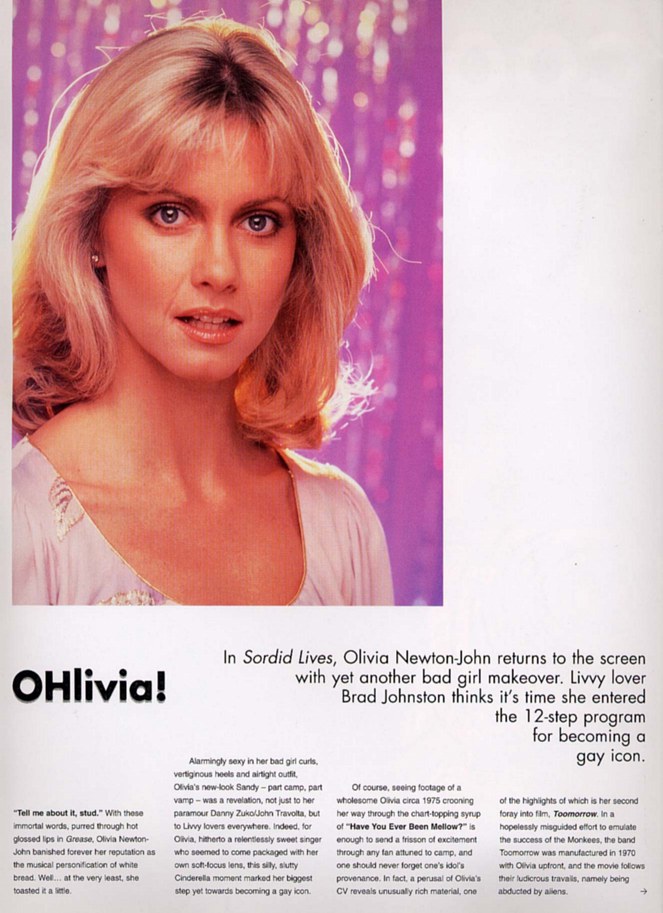
OHlivia!
In Sordid Lives, Olivia Newton-John returns to the screen with yet another bad girl makeover. Livvy lover Brad Johnston thinks it's time she entered the 12-step program for becoming a gay icon
“Tell me about it, stud”, with these immortal words, purred through hot glossed lips in Grease, Olivia Newton John banished forever her reputation as the musical personification of white bread. Well at the very least, she toasted it a little.
Alarmingly sexy in her bad girl curls, vertiginous heels and airtight outfit Olivia’s new-look Sandy - part camp, part vamp, not just to her paramour Danny Zuko, John Travolta, but to Livvy lovers everywhere. Indeed, for Olivia, hitherto a relentlessly sweet singer who seemed to come packaged with her own soft-focus lens, this silly, slutty Cinderella moment marked her biggest step yet towards becoming a gay icon.
Of course, seeing footage of a wholesome Olivia circa 1975 crooning her way through the chart-topping syrup of “Have You Ever Been Mellow?” is enough to send a frisson of excitement through any fan attuned to camp, and one should never forget one’s idol’s provenance. In fact, a perusal of Olivia’s CV reveals unusually rich material, one of the highlights of which is her second foray into film, Toomorrow. In a hopelessly misguided effort to emulate the success of the Monkees, the band Toomorrow was manufactured in 1970 with Olivia upfront, and the movie follows their ludicrous travail, namely being abducted by aliens.
Not surprisingly, it failed to ignite much excitement, but in respect its unavailability on video seems like grave injustice. One can’t help but it would otherwise be a beloved camp class and in terms of obscurely fabulous moments from Olivia’s past up there with the fact that she won a talent contest (and a trip to England) in 1965 by singing the demented showstopper, “Everything’s Coming Up Roses”, from the musical Gypsy. One can only assume she didn’t attempt to channel Ethel Merman.
But back to Grease. After all, her act of self-transformation in the film is were it gets really interesting, not only in terms of commercial success, but also for the fact that it heralded bent for image manipulation that preceded that of Madonna’s. Sadly, the first instalment was disastrous.
Olivia unwisely returned to ethereal purity in 1900 as the muse Kira in the execrable Xanadu. While the film’s sheer dullness denies it even kitsch value, it did yield two elements which could be considered rungs on Livvy’s ladder to icon status. First, there’s her peasant dress and leg warmer ensemble, which not only managed, miraculously, not to look hideous, but also cleverly disguised her notoriously thick ankles. Then there’s Matt Lattanzi, a dancing extra in the film, who was to become her husband and the father of her daughter, Chloe. This wouldn’t be worthy of inclusion weren’t for Lattanzi’s physical presence. Suffice it to say, he’s probably more camp than Olivia ever will be.
Olivia succeeded in putting Xanadu behind her swiftly and in style. Just one year later, she unleashed the album Physical, and the title track became the second longest running number one in the US at the time. Like a proto-Sporty Spice, Olivia was a sensation in her tousled crop, headband and leotard, tongue planted firmly in cheek as she aerobicised her way through the legendary clip. Populated as it was with gleaming muscle Marys-who famously ignored our her nd sashayed off in pairs - it was a music video landmark and contributed much to the song’s worldwide success.
It was to be her last major hit, but the intervening years have by no means been fruitless. In 1983, she launched the adorably tacky Australian-themed retail venture, Koala Blue. At the opening of the first store on Melrose Avenue in LA Dame Edna Everage summed up its appeal in a poem, which included the following lines, “The Australian male a gorgeous hunk, in defeat he’s modest, victory, drunk/Our women folk are, I’m sure you’re agree, as talented and tasteful as Livvy and me.” Despite is invaluable PR, the chain filed for bankruptcy eight years later.
Fortunately, Olivia had other creative avenues. She honoured the fine tradition of made-for-TV schmaltz in 1990, playing a store mannequin that comes to life at Christmas to mother an orphaned child in A Mom For Christmas, truly a masterpiece of the genre. However, such camp triumphs have been few and far between, until last year when she resurfaced with yet another stunning makeover in the independent release, Sordid Lives
The award-winning film, a Texan farce written and directed by Del Shores (based on his play of the same name) features Olivia as Bitsy Mae Haring, a guitar-strumming, tattooed ex-con dyke. A sight stretch, you might say, but in the context of the film, quite unremarkable. After all it also includes an uncle institutionalised for his Tammy Wynette fixation and a dead grandmother whose demises triggered by a carelessly discarded wooden leg (don’t ask).
All in all, its a perversely perfect vehicle for Olivia cinematic comeback and fans everywhere will no doubt rejoice. As you might have calculated, it also marks her step becoming a true gay con. Makes you want to break into the chorus of “Magic”, doesn’t it?
Sordid Lives is screening as part of the Sydney Gay and Lesbian Mardi Gras Film Festival, presented by Queer Screen, February 14-25.